Barbie Dream Fest: A Brand Strategist's Breakdown of Where the Experience Broke, and Why It Matters
Updated: Apr 3
I saw what happened at Barbie Dream Fest and my brain immediately went into strategy mode. Like I couldn't turn it off.

Not because I wanted to pile on. Everyone was already doing that. But because this is exactly the kind of situation that shows what brand strategy actually does, or what happens when it isn't there.
I've spent over 20 years designing brand experiences. The kind where people walk in and immediately feel the intention behind every decision. Where the brand promise doesn't just live in the marketing, it lives in the room.
What happened at Barbie Dream Fest on March 27–29, 2026 at the Broward County Convention Center in Fort Lauderdale? The promise lived in the marketing. The room told a completely different story.
This is not a takedown. This is a debrief.
What Was Promised
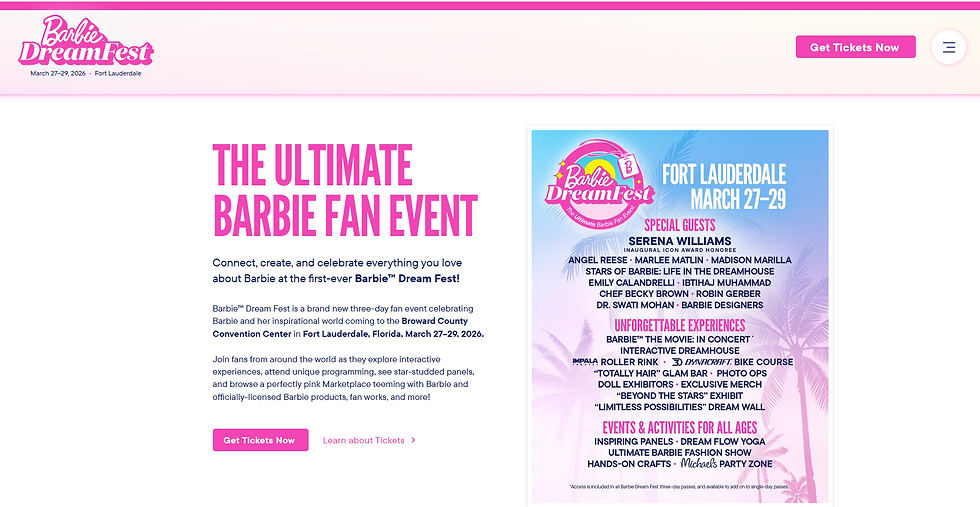
Mattel and event operator Mischief Management called this "the first festival dedicated to all things Barbie." The marketing was ambitious, interactive experiences, a walk-in Dream House, an '80s disco roller rink, star-studded panels, a curated marketplace, a bike course.
Celebrity guests included Serena Williams, Angel Reese, Marlee Matlin, and NASA engineer Dr. Swati Mohan. Tickets ranged from $72 for a single day to $452.50 for top-tier VIP. Families traveled from out of state. People booked hotels. One attendee spent over $1,000 on a Pink Pass and travel alone.
The expectation was immersion. The expectation was Barbie.
What People Walked Into
By Friday evening — opening day, it was already spreading across Reddit, X, and TikTok. The phrase "Barbie Nightmarefest" was coined within hours.

What attendees documented inside the Broward County Convention Center: sparse vendor tables, a roller disco that turned out to be a small barricaded square of concrete with a sign that said "Roller Disco," and a Dream House that was essentially a backdrop with fake grass. The VIP swag bag, for guests who paid $250 to $450, reportedly had a Barbie-branded hand sanitizer and a plastic brush. No bag. No exclusive merchandise.
People compared it to Fyre Festival. To the Glasgow Willy Wonka Experience. One attendee said they had "attended a careers expo that was more exciting than this hot mess."
That line is not just funny. It is precise. It tells you exactly what the room felt like.
Where the Experience Broke
The failure started before anyone walked through the door
Here is what most people are missing in this conversation. The problem was not the execution. The problem started in the strategy, specifically in the marketing.
When you use the word immersive, you are making a promise. When that promise is attached to Barbie, a brand built entirely on imagination, aspiration, and emotional identity, the stakes of that promise are enormous.
Barbie is not a product. She is a feeling. People have personal histories with her. Childhood memories. Emotional associations that span generations. When you invite those people to step into her world and charge them $72 to $452 to do it, you are not selling tickets. You are selling an emotional experience.
The moment the room doesn't match that feeling, the disappointment isn't just about the event. It's personal.
The venue was a tool they didn't know how to use
The Broward County Convention Center is a massive space. That is not a problem, it is actually an opportunity. But a large venue only works when you design for it deliberately.
When you don't, something specific happens. People don't feel like the space is big. They feel like the event is small. There is a difference and you feel it the second you walk in.
Wide open floors. Sparse activations scattered across a space that could hold thousands. That is not spaciousness. That is abandonment. And attendees felt it immediately on Friday.
A venue like that needs density, intentional flow, and zones that give people a reason to move through the space with purpose. What was described across multiple platforms was pass-through space. Areas people walked through without stopping because there was nothing pulling them in.
The format was wrong for the brand
This is the one that gets me the most because it should have been caught early.
Barbie Dream Fest was set up like a fan convention. Vendor booths, a marketplace, panels across the day. That format works for certain fandoms, communities built around collectibles or media properties where browsing a floor IS the experience.
Barbie is not that brand.
Barbie demands narrative. She demands immersion. She demands the feeling of stepping into a world. The 2023 film worked because it understood that completely. It didn't reference Barbieland, it built it. Three years later the official fan experience gave people a backdrop with fake grass.
This is not a production error. It is a strategic one. It should have been identified before a venue was booked, before a ticket was sold, before the marketing went live.
There was nothing to anchor the day
Every successful large-scale event has what I call anchored moments. Scheduled, non-negotiable experiences that give people a reason to plan their day, move through the space, and feel like something is always happening.
Without them, energy stays flat. People drift. The experience becomes passive, which is the exact opposite of immersive.
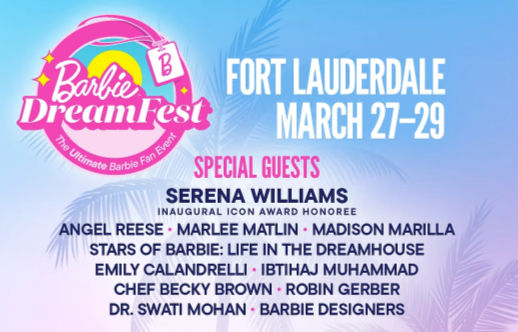
The celebrity lineup was genuinely strong. Serena Williams, Angel Reese, that is real talent. But talent alone cannot carry an event when the environment around it doesn't support it. When the room feels empty, even the most compelling speaker loses the energy they deserve.
The celebrities were supposed to be part of the experience architecture. Instead they appear to have been the entire architecture.
The Barbie brand ecosystem was sitting right there
This is the one I keep coming back to.
Barbie is one of the most partnered consumer brands in the world. Fashion. Beauty. Retail. Lifestyle. The list of brands that want to be in the same room as Barbie's audience is long and commercially powerful.
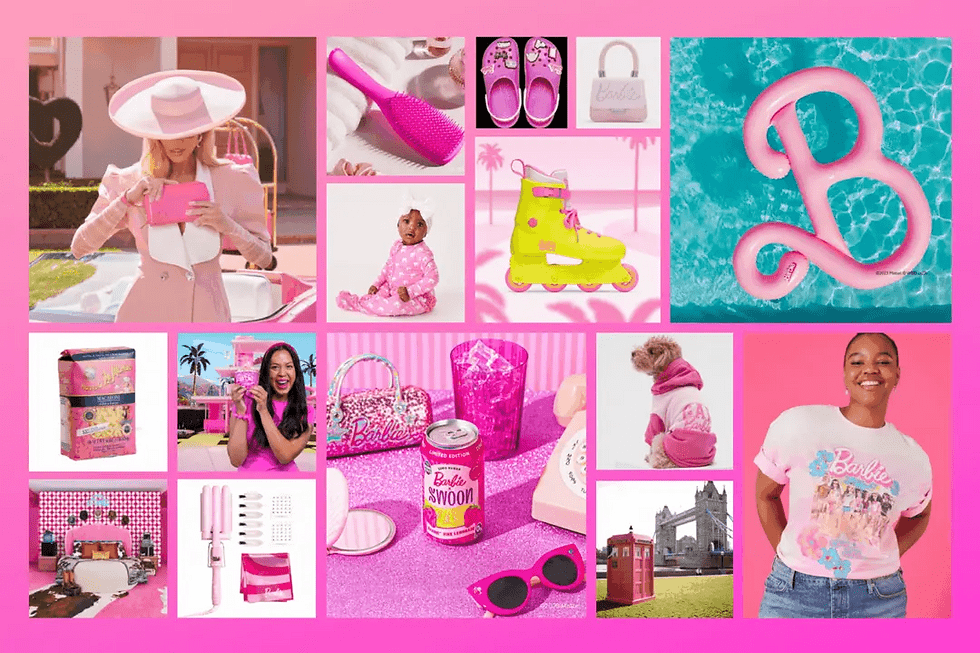
A Barbie fan festival is a natural home for exclusive drops, co-branded activations, and brand partnerships that feel elevated and intentional. A beauty brand doing a Dream House makeup moment. A fashion brand dropping a Barbie-inspired capsule. A retailer creating something people can experience, photograph, and take home.
None of that was in the room.
What was there instead was a vendor model, small businesses operating alongside a licensed brand they couldn't legally produce products for. Which means in a Barbie event, most vendors couldn't sell anything that was actually Barbie. That is a structural planning failure. It limited the depth of the marketplace before it even opened.
The ecosystem existed. It just wasn't invited.
The activations didn't give people a reason to stop
Every activation should answer one question: why am I here?
Not what am I looking at, but "Why am I HERE? What is this space asking me to do or feel that I could not do anywhere else?"

The roller disco didn't answer that. A concrete square with a sign is not a roller disco, it is a gesture toward one. The Dream House didn't answer it either. A backdrop is not a world you step into.
When people pass through an activation without engaging it is not because they are not interested. It is because the activation didn't give them a reason to be.
At $72 to $452 a ticket, gestures don't land.
It was built for attendance, not for the attendee
This is the distinction that separates event production from experience design.
Filling a room and serving the people inside it are two different things. What the feedback from Barbie Dream Fest describes consistently, the sparse floor, the limited activations, the swag bag that didn't deliver, the confusion about where things were, is the experience of an event that planned for volume without designing for the individual.
Experiential marketing is not about headcount. It is about what people felt while they were there, what they said when they left, and what they posted while it was still happening.
Every metric that actually matters, brand sentiment, social amplification, loyalty, flows from the quality of that individual experience. Not how many people came through the door.

The real-time social response became the story
This is the part brands need to understand in 2026.
Your event is not judged after the fact. It is judged while it is happening.
The moment the first attendee posted a video of that concrete square next to a sign that said "Roller Disco," that video became the event. Not the marketing materials. Not the press release. The unfiltered documentation from people inside the room, that is the permanent record now.
Barbie Dream Fest was being compared to Fyre Festival on opening day. The event was still running. Celebrities were still scheduled. And the narrative was already written, not by media, by attendees posting in real time.
This is not a social media problem. It is an experience design problem that social media made visible.
When an experience is built with intention, organic content amplifies the brand. When it isn't, that same content becomes the crisis.
The event you build in the room is the event the world sees online. Those are not two separate things anymore.
Why This Matters Beyond This Weekend
The Fyre Festival and Willy Wonka comparisons are not just viral moments. They represent something specific. They happen when the gap between what was promised and what was delivered is large enough, visible enough, and expensive enough that people feel it collectively.
Brands that end up in that conversation don't just have a bad weekend. They carry that association. It becomes part of how people talk about them.
For Barbie, a brand whose entire identity is built on imagination and the feeling that anything is possible, that is not a small thing.
Live experiences are brand strategy now. They are how a brand proves in real time whether its values are actually real. When the experience doesn't match the promise it is not just a bad event. It is a brand statement. And it takes a lot more to undo than it did to make.
The Bigger Picture
Barbie Dream Fest is not an isolated incident. It is part of a pattern; strong brand, compelling marketing, execution that does not connect the two.
The brands getting it right start from the inside out. From what it feels like to be inside the room. Not from the outside in, building marketing around a concept that was never fully built on the floor.
The difference between an experience people talk about for years and one that becomes a cautionary case study is not budget. It is not brand recognition. It is not even the venue.
It is the decision to treat the experience as a strategic discipline, not a production checklist.
This is Part One of a two-part case study. Part Two is the full redesign, every activation, before and after, with the strategy behind each decision. Same brand. Same venue. Built the way it should have been.
© ©2026 by Erika Hernandez. All rights reserved. This case study is original analysis and professional commentary.


Comments